Conversational Hebrew Club “Let’s Talk!” (2016–2022)
The Conversational Hebrew Club program “Let’s Talk?” has been operating since 2016.
Thanks to the support of the Dutch Humanitarian Fund, the World Confederation of United Zionists (CUZ), Keren HaYedidut, and the Vaad of Ukraine, the Club’s activities were significantly expanded in 2020.
In addition to Kyiv, branches of the Club operate in Chernivtsi, Melitopol, Kharkiv, and Lviv.
Over five years of activity, the Club has developed its own style and original methodology for conducting meetings.
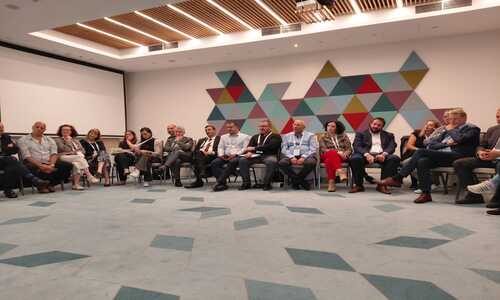
This program is the first of its kind in Ukraine and represents a natural continuation of ulpan-based Hebrew studies. Club meetings are held in the form of discussions on pre-announced topics.
Since March 2020, all Conversational Hebrew Clubs have been moved online. Today, anyone from any country in the world who speaks Ukrainian or Russian, as well as Hebrew, can join the Club’s activities.
On August 28, 2019, the methodological guidelines for conducting meetings of the Club were approved by V. I. Vernadsky Taurida National University as an educational manual and recommended for higher education institutions where Hebrew is taught.
Most Club meetings are dedicated to Jewish tradition, Jewish holidays, and community events.
A special place in the Club’s activities is given to meetings with individuals who speak Hebrew at a native level.
In 2019–2020, the Club welcomed civic activist Rina Barbut (Israel).
Guests of the Conversational Hebrew Club have included: Ron Garfield – Head of the “Jewish Agency for Israel in Ukraine”; Dmytro Ioffe – Head of the Aliyah Department of the “Jewish Agency for Israel in Ukraine”; traveler and businessman Ram Rosenfeld; founder of a falafel restaurant chain in Ukraine Guy Dotan; director of the Traditional Judaism community Michal Stamova; director of the Jewish Education Center of Ukraine Natalia Bakulina; and founders of the Israeli heritage community “Meeting Place” Anna and Meir Antopolsky, among others.
The establishment of the Conversational Hebrew Club has helped most participants not only improve their spoken Hebrew but also find like-minded people, gain new knowledge about Jewish tradition and lifestyle, and take part in Jewish holidays and community events. Although non-religious in nature, the program plays and continues to play an important role in uniting members of the Jewish community.
2019 Methodological Guidelines for the All-Ukrainian Project “Conversational Hebrew Club ‘Let’s Talk?!’”
The methodological guidelines for conducting meetings of the All-Ukrainian project “Conversational Hebrew Club ‘Let’s Talk?!’” represent the first attempt in the history of Hebrew language teaching to move away from the traditional, long-established Israeli methodology used both in Israel and in the diaspora. This traditional approach often focuses on dry grammar instruction or vocabulary lists without providing sufficient opportunities to practice speaking.
This program is the first in Ukraine to operate in such a format and serves as a continuation of ulpan-based learning. Club meetings are held as conversations on pre-selected topics.
The guidelines present unique methods that not only explain the originality of the approach compared to standard teaching methods, but also assist Club moderators in organizing meetings and selecting engaging materials.
In the introduction, written in a vivid and emotionally rich style by Hebrew language specialist and graduate of Kyiv National Linguistic University Ksenia Yerofieieva, the novelty of the program is described, along with its differences from classical Hebrew teaching. The author also provides practical advice on creating a warm and welcoming club atmosphere and suggests a wide range of discussion topics suitable for participants with different levels of vocabulary and proficiency.
The second part of the publication is devoted to practical examples, including a minute-by-minute plan of a standard Club meeting, sample tasks, topics, and discussion questions.
The final section includes examples of exercises and Hebrew songs that can be used during meetings. Links to these materials are provided via QR codes, representing a modern method of sharing resources in printed publications.
Also of interest are articles by Club moderators and Hebrew teachers Lyudmyla Shapiro (Melitopol) and Olena Hrebelna (Chernivtsi), who share their unique experience in conducting Club meetings and provide practical recommendations that may assist new moderators in organizing sessions and generating ideas.
This methodology of conducting Conversational Hebrew Clubs is entirely new and can be recommended both as an elective course and for inclusion in the core curriculum of Hebrew language instruction in higher education institutions.