Leadership of the Zionist Federation of Ukraine on the WZO сonference in Budapest
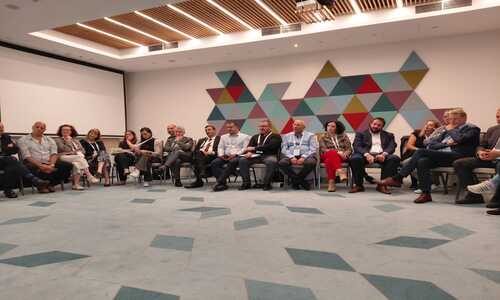
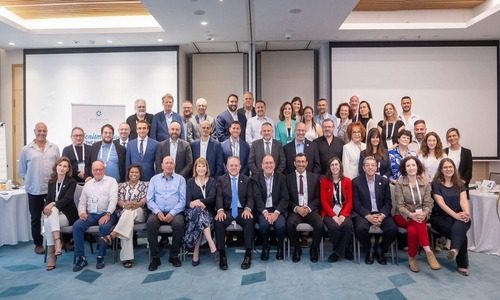
In June, in Budapest (Hungary), the Department for Irgoon and Connection with Israelis Abroad of the World Zionist Organization (WZO) held a conference that brought together leaders of Zionist federations from various countries around the world.
Ukraine was represented at the event by the Executive and Program Director of the Zionist Federation of Ukraine, Olena Zaslavska, and the Chairman of the Board, Gershon Bilorytskyi. Since the beginning of the full-scale war, this is the second conference of this level in which representatives of the Federation have taken part. Overall, Ukrainian representatives have participated in such events four times.
Later, Olena Zaslavska shared her impressions of the event:
“I have taken part in events organized by the Department for Irgoon and Connection with Israelis Abroad of the World Zionist Organization (WZO) before, but this conference in Budapest made a particularly strong impression on me — both in terms of organization and content.
I have long been trying to explain to my Israeli colleagues from various organizations that work in diaspora communities cannot and should not be based solely on the idea of immigration to Israel, the Aliyah. This was necessary in the early years of the State, when the young democratic country, surrounded by hostile neighbors, required the efforts of everyone who felt a connection to the land. Today, Israel is one of the strongest countries in the world, and the arrival of a few thousand new immigrants does not significantly change its overall development trajectory. Instead, these people can contribute by improving perceptions of Israel in the countries where they live. And this, in my view, is extremely important.
At this conference, I realized that Israeli organizations, which from the very beginning of the Zionist idea were focused exclusively on supporting Aliyah, are now gradually turning toward those communities that do not intend to move to Israel but are nevertheless highly influential, consider Israel their homeland, and seek to support it from where they live. This is a very positive development that gives hope that our work will be properly recognized and supported.”
Overall, the situation was described in a panel titled Federation: Identity, Purpose, and Collaboration by Gershon Bilorytskyi:
“Before the war, in Ukraine, we were experiencing a real revival of Jewish life following the collapse of the Soviet Union. Jewish communities were actively developing: schools and kindergartens were opening, and various community projects were being implemented. Everything seemed to be moving forward with good prospects. That was the situation until February 2022.
At the very beginning of the full-scale invasion, everyone was in shock. No one could believe it was really happening. We did not know what to do next, what our role as a Jewish community should be, whether we could remain in the region, and how we would survive under the new circumstances.
At that time, we focused on helping Jewish communities and individuals with evacuation and relocation. The first weeks were extremely difficult. But day by day, we began to better understand the logic of the war and learned how to interact with government institutions, Israeli and European partners, Ukrainian officials, and military representatives.
Today, we can say that we live in a certain routine. But that does not mean everything is fine or that there is less work. On the contrary — our task now is the rebuilding of communities.
We are reopening schools — sometimes with the same people, but in new locations. In some cases, a community from Donetsk or Luhansk regions has to be practically recreated in Kyiv or in the Carpathian region. This is not an easy process.
Another important challenge has been the issue of Jewish servicemen. Some of them are religious and wish to observe kashrut. Therefore, we have been cooperating with the Ministry of Defense to develop the institution of military rabbis-chaplains. We also try to provide kosher food for soldiers wherever possible and offer them religious support.
We also work with refugees. We help rebuild Jewish life in different countries.
We are a Zionist organization, so if someone asks us where to begin a new chapter of life, we naturally recommend Israel. But if a person is not ready for that or has strong reasons to remain in Budapest, Poland, the United Kingdom, or any other country, we respond: ‘Alright, let’s help you find a local Jewish community. Let’s introduce you to people. Let’s rebuild and strengthen the community together,’” said Gershon Bilorytskyi during the panel discussion.